

Insights - interview > Tinku Gupta: Resiliency, Perspective and the Power of Pause
Leadership Perspectives
- Published on
Tinku Gupta: Resiliency, Perspective and the Power of Pause
In moving between the executive suite and the boardroom, the tech stalwart has learned that leadership is as much about perspective as it is about performance.
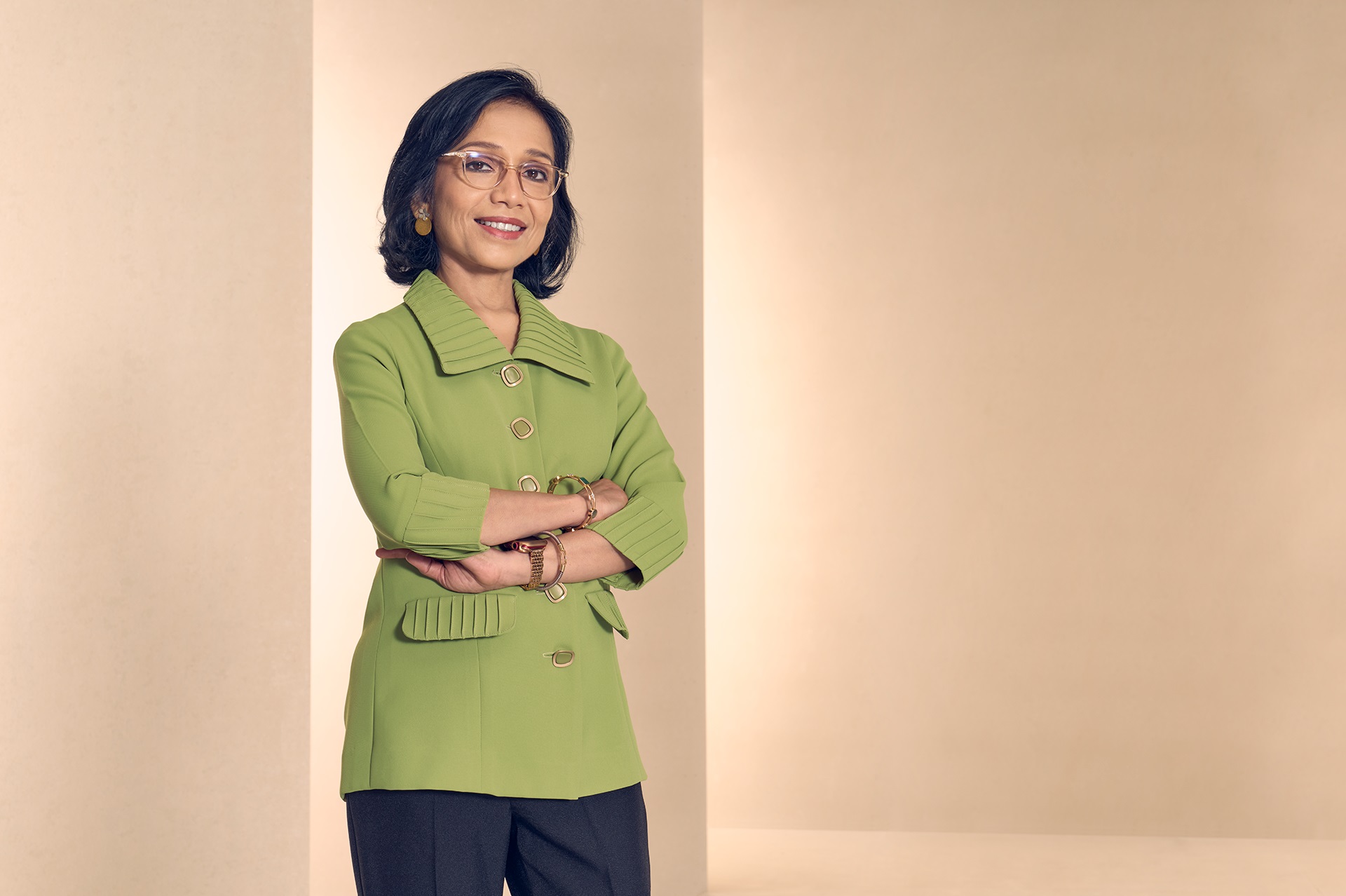
Tinku Gupta routinely tells herself to “pause and play”. It may sound like a mindfulness technique for inner calm, but what the 30-year business and technology veteran is doing is taking a moment to switch hats.
For the last few years, the SGX Group Chief Information Officer (CIO) has balanced duties at the multi-asset exchange with governing board duties at both the Singapore University of Social Sciences (SUSS) and Singapore Institute of Management (SIM). It is in the car, on her way to a board meeting, that this quick recalibration usually takes place.
For executives still immersed in the operational, stepping into the boardroom requires a deliberate mindset shift – from driving the engine to charting its course – as solution-centric instincts can easily drift into management’s remit.
“At the start, my challenge was in the switching. I was so tempted to solve problems. But a board’s role is to listen and to ask questions. That’s why I always say to myself, ‘Tinku, pause’. There needs to be this awareness,” she shares.
Resilient by Design
A software developer when she joined SGX in 1996 (then known as SIMEX), Gupta later took on diverse roles in technology and business, including running the Group’s Market Data and Connectivity business. Later, as SGX Group’s Chief Technology Officer at the time of the Covid-19 pandemic, her team ensured 100% uptime for the exchange, even as major players encountered disruptions from technological failures.
The unprecedented black swan event served as a real-world proof point of Gupta’s three-word mantra: Resilient by design – resilience not at as reaction to crisis but intentionally built into systems, teams and decisions.
Citing board responsibilities as one example, she says, “There’s no playbook for the unknowns. In the context of the boardroom, what the board can offer management is a second lens. We challenge and think through scenarios that may be in the management’s blind spot and ask what’s plan B if this one fails. If management is glass-half-full, we may take it on ourselves to be glass-half-empty. If management is too conservative, we may push them along.”
On a personal level, she adds, “This means you tell yourself: ‘I will not fail. And if I do fail, I will learn from the failure and rise again.’”
Technology as Catalyst
In the boardroom, tech fluency has become a non-negotiable leadership skill for oversight and aligning technology initiatives with business goals.
“If a business needs IT to have a competitive advantage, to engage customers, and to grow, then tech is the nervous system. It’s about connecting all the wires that run through different parts of the body, so that every part of the organisation works and is able to run or change fast. IT is a catalyst,” she observes.
“All board members today speak IT. There’s no doubt about it. But the tech voice brings realism and a balanced viewpoint to the collective thinking,” she continues. “In areas like cyber, AI and data, specialisation by way of learned experience and an ability to read signals adds to the board’s collective knowledge. It is also important that the practitioner has a business lens.”
Just as the financial services sector has had to strengthen its IT infrastructure amid rapid change, so too has higher education.
As board director, Gupta is stewarding this transformation at two segments of the sector. SIM is a private education institution under the purview of the Charities Act, while SUSS is a government-funded autonomous university. A lifelong learner, Gupta is herself a direct participant – and beneficiary – of the technology-enabled education ecosystem. Alongside multiple commitments, she is currently enrolled in a six‑month, online AI for Senior Executives programme at NUS.
“With my current roles, I wouldn’t even have dreamt of doing an AI course if it was not held online. We may not meet in-person, but the course content is enriching, and I spend my weekends completing assignments. Virtual courses would not have taken off if the education sector did not have good technology leaders,” she says.
Diversity in the Talent Pool
Mention gender diversity, or the benefits of appointing younger directors to widen a board’s traditional competencies, and Gupta is quick to resist easy categorisation. “What’s important is the mix. It’s about board capability. Fresh energy and new ways of looking at issues are what ‘younger’ represents, metaphorically.”
“And in discussing diversity and equity, it’s not just gender. It’s about everything, including cultural diversity, age diversity, and the depth, breadth and youthfulness of experience,” she stresses.
The philosophy extends beyond the rhetoric and is borne out of practice. Even a casual observer would note that the boards of SIM, SUSS, and SGX, reflect fit-for purpose diversity – broadly diverse and gender-balanced, drawing leaders from a range of fields, backgrounds and experiences in service of the organisation’s strategic objectives.
The idea of pursuing a board appointment was first raised by Euleen Goh, SIM’s current Chair and a defining example of women in leadership whose chairmanship of SATS (2013 – 2024) oversaw its transformation into one of the world’s largest air cargo handlers.
“It was during Covid when she emailed me one day and said, ‘I want to talk to you about board experience.’ She remembered me from a lunch where she had asked for my views on Silicon Valley. I shared that while Silicon Valley and Singapore have much in common, Silicon Valley has a stronger appetite for trying, learning, and iterating. Here, we sometimes hold ourselves to such high standards that we become risk averse. Yet in technology led transformation, progress often depends on a willingness to learn from setbacks. That perspective, I suspect, resonated with her.”
100% Commitment; 200% Preparation
New to the education sector, Gupta saw a seat on the SIM board as an opportunity to broaden her horizons. Five years on – and serving on the board of a second university – she reflects: “As a board member, I prefer to go to other sectors so that I can learn. You also have less baggage and don’t have to worry about conflicts of interest. Your greatest achievement is making the company’s management successful – you’re an enabler.”
She points to SGX’s job rotation strategy for high-potential executives for stretching her experience and building the holistic perspective needed to step into a board role. Such efforts enhance an executive’s agility, increases their retention, and acts as a pipeline for future leadership.
Both a proponent of multi-dimensional diversity and a consistent advocate for women in leadership, Gupta is keen to see more women rise into the highest rungs of leadership. “We have the talent. We have perseverance. We can be challenged. So you know you can trust us.”
“If I may make a statement,” she adds, “it’s this: Don’t see the woman part of the talent; see the talent in the woman.”
But for Gupta, expanding access to board leadership is inseparable from a clear-eyed understanding of what board responsibility truly entails. For those considering a first board role – regardless of demography – she cautions against viewing it as a line item in a LinkedIn profile or as part of personal branding.
“It’s a high-stakes responsibility. You need to commit 100 per cent and come 200 per cent prepared. You need to contribute and be in good service to the board – that only works if you are genuinely invested.”